

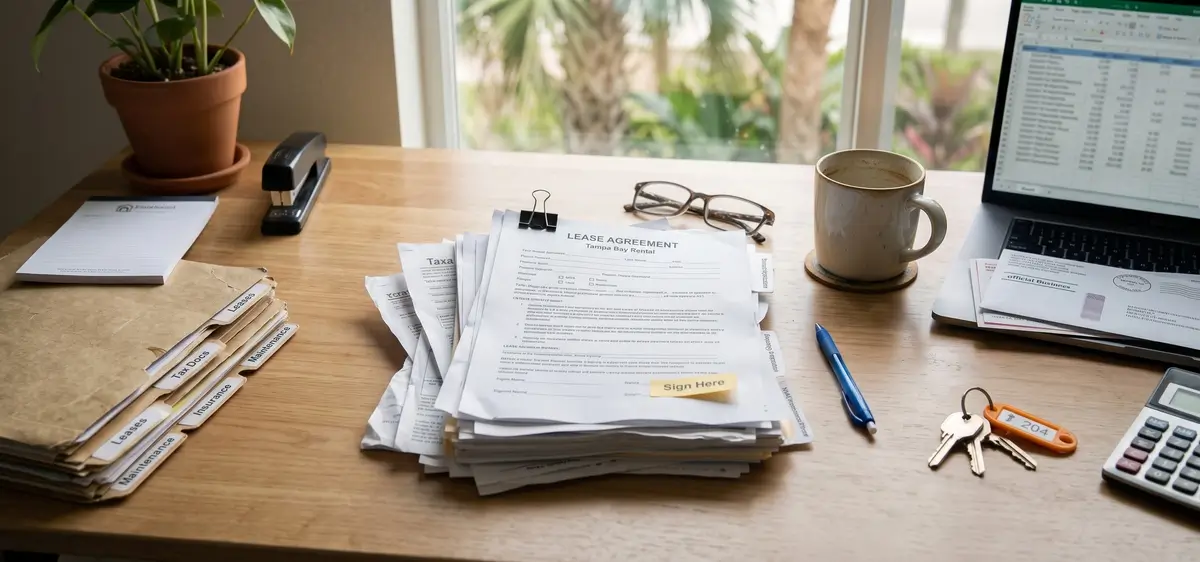
A hurricane warning gives Tampa Bay owners a few days to prepare. A missing document gives no warning at all, and it usually surfaces during an insurance claim, a deposit dispute, or an IRS question. Good records protect you at tax time, in disputes, and during claims, especially alongside accurate accounting and reporting. Every Tampa Bay rental owner should keep 6 types of records: financial, tenant and lease, Florida disclosures, inspection and maintenance, insurance and storm, and HOA documents, if your rental is in an association.
Key Takeaways
- Capital improvement records document a higher cost basis, which can lower your tax bill when you sell.
- Florida now requires a separate flood disclosure for leases of 1 year or longer.
- Consistent screening files and delivered notices strengthen your position if a tenant decision is challenged.
- Dated photos and off-site backups give you a strong advantage after storms and disputes.
Ownership, Tax, and Financial Records for Your Rental Property
Financial records prove what you paid, earned, and spent, supporting both your tax returns and your eventual sale.
Purchase and Closing Documents
These records establish your starting cost basis. Keep them for as long as you own the property and at least 3 years after you sell:
- Closing statement
- Deed and title insurance policy
- Purchase agreement and addenda
- Loan documents
Capital Improvement Records That Protect Your Cost Basis
Tampa Bay owners replace roofs, HVAC systems, and windows often, so save the invoices, permits, and before-and-after photos for each project. Capital improvements raise your cost basis, which can lower your capital gains tax at sale.
Income, Expense, and Owner Statement Records
Use a dedicated bank account, and keep receipts, bank statements, and mileage logs. A reliable rent collection system keeps income records consistent. The IRS generally has 3 years to audit a return. That window extends to 6 years if you omit income that exceeds 25 percent of the gross income shown on your return, so many owners keep records for 7 years. Also keep your management agreement, monthly owner statements, and year-end tax forms. Our owners receive monthly statements and 1099-S, with anytime access to reporting through the Rentvine owner portal.
Tenant Screening and Lease Records
Complete tenant files help you defend screening decisions and enforce lease terms.
Applications and Screening Authorizations
Keep accepted, denied, and withdrawn applications, along with signed consent for background and credit checks. Apply a thorough tenant screening process the same way to every applicant. Consistent records help you show fair housing compliance if a decision is questioned.
Signed Leases, Amendments, and Renewals
Store the original lease with every addendum, amendment, and renewal. Together, they show the full agreement at any point in the tenancy.
Notices and Tenant Communications
Keep each notice with proof of delivery, including:
- 3-day notices for unpaid rent
- 7-day notices for lease violations
- Notices of entry
- Non-renewal notices
Save related emails, texts, and portal messages too.
Florida Disclosures and Security Deposit Records
Florida requires specific disclosures and deposit notices, and signed copies prove you delivered them.
Required Lease Disclosures
Keep signed copies of these disclosures with the lease:
- Radon gas disclosure, required in Florida rental agreements
- Lead-based paint disclosure for homes built before 1978
- Name and address of the landlord or authorized agent
Flood Disclosure Under Florida Statute 83.512
Since October 1, 2025, Florida Statute 83.512 has required a flood disclosure at or before signing a lease of 1 year or longer. It must be a separate document. The form states whether, during your ownership, you know of flood damage to the unit, filed a flood insurance claim, or received assistance such as FEMA aid.
Security Deposit Notices Under Florida Statute 83.49
Under Florida Statute 83.49, you must give written notice of how the deposit is held, either in the lease or within 30 days of receiving it. After move-out, you have:
- 15 days to return the full deposit if you are not making a claim
- 30 days to send written notice of a claim by certified mail, or by email where permitted
Keep mailing receipts and itemized deduction records.
Inspection and Maintenance Records
These records show your property's condition over time and turn disagreements into documented facts.
Move-In and Move-Out Inspection Reports
Capture dated photos and video of every room, appliance, and fixture at move-in and move-out. Side-by-side comparisons make it easier to separate normal wear and tear from actual damage.
Routine Inspections and Maintenance History
Keep inspection reports, work orders, vendor invoices, warranties, and manuals. Together, they reveal recurring problems and show that repairs were handled promptly.
Insurance, Storm, and HOA Records for Tampa Bay Properties
Storms and association rules add extra paperwork for local owners.
Insurance Policies and Florida Inspection Reports
Keep landlord and flood policies, claim files, and tenants' proof of renters insurance. Wind mitigation reports may qualify you for premium discounts, and many insurers request 4-point inspections for older homes.
Hurricane and Flood Documentation
Photograph the property before each hurricane season, and record any damage right after a storm. These images support claims and help you complete the flood disclosure accurately.
HOA Governing Documents and Approvals
Keep the covenants, rules, tenant approval forms, assessment records, and violation notices. Owners typically remain responsible to the association when tenants break community rules.
Smart Ways to Store and Organize Rental Records
A good system keeps records easy to find and safe.
A Simple Retention Schedule for Rental Records
- While you own the property, plus 3 years after sale: purchase and capital improvement records
- 7 years: tax returns and income and expense records
- Several years after move-out (many owners keep 7): tenant files and deposit records
- At least until any open claims are settled: expired insurance policies
Backup and Secure Disposal
The IRS accepts digital records, so back everything up to the cloud or off-site. Shred paper records once their retention period ends to prevent identity theft.
FAQs
1. How long should I keep tax records for my rental property?
The IRS generally has 3 years to audit a return, or 6 years if omitted income exceeded 25% of the gross income reported, so 7 years is a safe standard. Keep purchase and improvement records while you own the property and at least 3 years after you sell.
2. Do I need a flood disclosure if my rental has never flooded?
Yes, Florida requires it for any lease of 1 year or longer, regardless of flood history. Mark that you have no knowledge of flooding, claims, or assistance, and keep the signed copy.
3. What happens if I miss the 30-day deadline to claim part of a security deposit?
You can lose the right to deduct from the deposit, though you may still sue separately for damages. Send the notice on time by certified mail and keep the receipt with your itemized deductions.
4. Can I keep rental records digitally instead of on paper?
Yes, the IRS accepts digital records that are complete and readable. Store backups in the cloud or off-site, and shred paper originals you no longer need.
Records Do Their Best Work Before You Need Them
In Tampa Bay, problems rarely come one at a time. A single storm can bring an insurance claim, a repair dispute, and a tax question all at once. Organized owners handle these as routine tasks. At PMI Arrico Realty and Property Management, we help local owners manage leases, disclosures, inspections, and financial records. If you want your paperwork ready for whatever comes next, explore our residential property management services.